 WhatsApp:+86 155 1698 1316
 WeChat:+86 155 1698 1316
 Email:sales@rotarykilnchina.com
Coal gangue, the dark by‑product of coal mining, has long been a challenging solid waste for China’s energy‑intensive regions. In Jingyang, Shaanxi Province, a new 300‑ton‑per‑day production line, engineered and supplied by Henan Hongke Heavy Machinery Co., Ltd., is rewriting that narrative. This project demonstrates how advanced rotary kiln technology can convert low‑value waste into high‑brightness calcined kaolin – a sought‑after raw material for ceramics, paper, rubber, and paints.
The line operates continuously, processing run‑of‑mine gangue through a carefully designed beneficiation and thermal treatment route. The result: a white, stable, and chemically inert product that replaces natural kaolin, reducing mining pressure and landfilling simultaneously.
The Challenge: Coal Gangue Accumulation in Shaanxi
The Jingyang area, like many parts of Shaanxi, faces significant stockpiles of coal gangue. Uncontrolled storage leads to:
Spontaneous combustion and air pollution
Leaching of heavy metals into groundwater
Occupation of valuable agricultural or industrial land
Local regulations increasingly favour zero‑waste solutions. The 300 t/d line was conceived to meet both environmental compliance and commercial viability – turning a liability into a revenue stream.
The Hongke Solution: End‑to‑End Process Engineering
Henan Hongke Machinery provided not just the rotary kiln, but the entire process chain – from raw material preparation to finished product storage. The production flow comprises four core stages:
1. Crushing & Grinding
Run‑of‑mine coal gangue (≤300 mm) is first crushed to <25 mm, then fed into a ball mill for dry grinding to 200‑mesh fineness. This unlocks the mineral structure, making subsequent separation more effective.
2. Slurrying & Classification
The ground powder is mixed with water and dispersants to form a stable slurry (solids content ~45‑50%). Hydrocyclones and spiral classifiers remove coarse impurities (quartz, pyrite, and carbon residues). This wet beneficiation raises the Al₂O₃ content from ~35% to over 42%, while reducing Fe₂O₃ and TiO₂ – critical for final whiteness.
3. Mechanical Dewatering & Pre‑drying
The classified fine slurry is thickened, filtered, and partially dried to a moisture content of 12‑15%. A pre‑dryer reduces the thermal load on the rotary kiln, improving energy efficiency.
4. High‑Temperature Calcination in Rotary Kiln
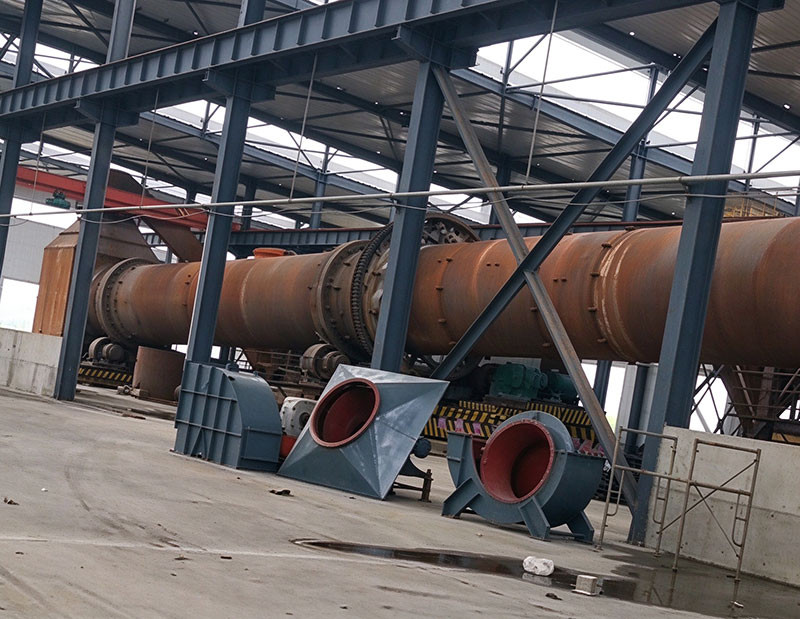
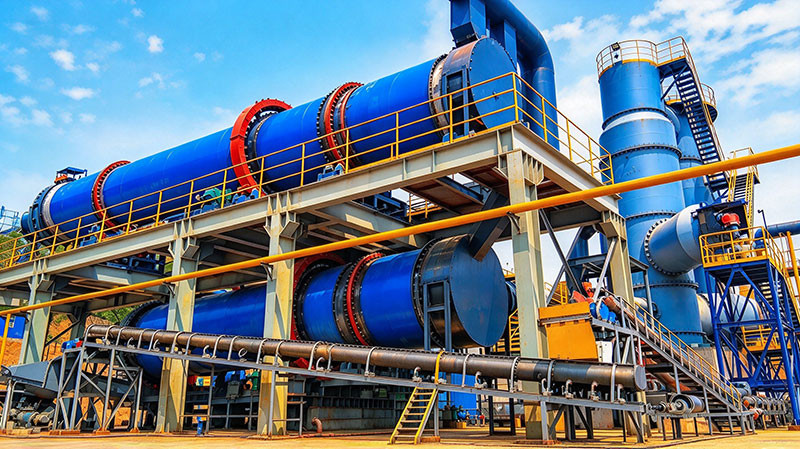
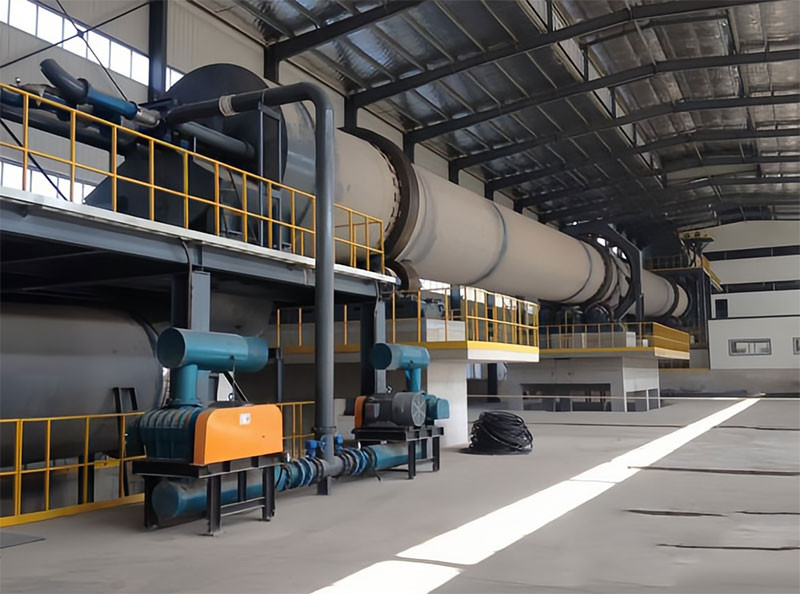
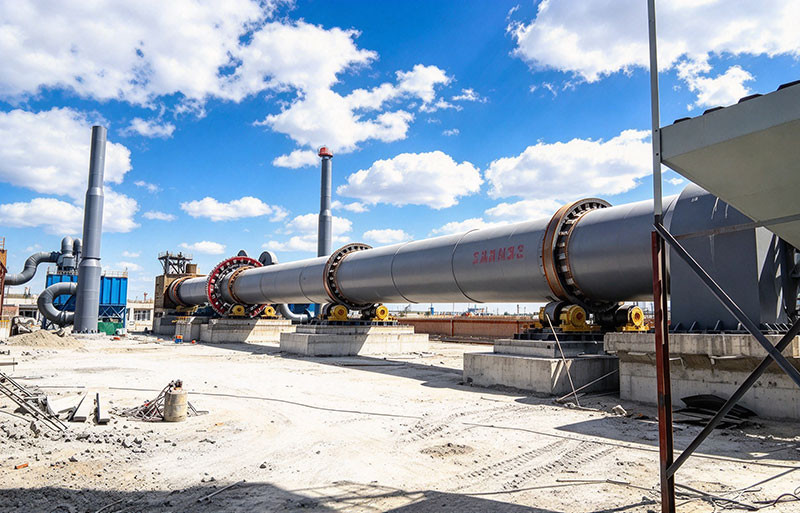
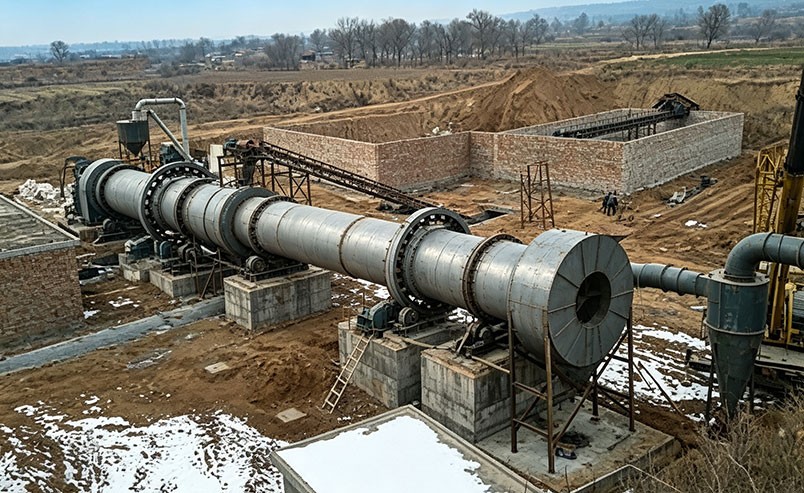
This is the heart of the line. The prepared material enters the Φ2.8×46 m rotary kiln (designed for 300 t/d throughput). The kiln operates at a maximum temperature of 1,050‑1,150°C, with a retention time of 40‑60 minutes.
During calcination:
Dehydroxylation removes structural OH⁻ groups, breaking the layered lattice of kaolinite.
Amorphisation transforms the crystalline structure into metakaolin, which then recrystallises into spinel and mullite phases.
Carbon burnout eliminates residual organic matter, raising the L* whiteness value from <40% to >88% (ISO brightness).
The rotary kiln features:
Variable frequency drive for precise speed control (0.2‑1.2 rpm)
High‑alumina refractory lining (working layer ≥150 mm) for extended campaign life
Multi‑channel burner capable of firing pulverised coal, natural gas, or waste‑derived fuels
Advanced sealing system (spring‑loaded graphite blocks) to minimise air infiltration and maintain temperature uniformity
A downstream cooling system (horizontal grate cooler) quenches the hot calcined product to <100°C, locking in the metastable reactive phases.
Product Output: Calcined Kaolin with Superior Properties
The final product – white calcined kaolin – meets the following typical specifications:
| Parameter | Value |
|---|---|
| Whiteness (ISO) | 88‑92% |
| Al₂O₃ content | 44‑46% |
| Fe₂O₃ | <0.5% |
| TiO₂ | <0.3% |
| Loss on ignition | <0.8% |
| Residue (325 mesh) | <0.02% |
| Oil absorption | 50‑55 g/100g |
This grade is directly substitutable for water‑washed or calcined natural kaolin in:
Ceramic tiles and sanitaryware (opacifier and flux)
Paper coating (improves brightness and printability)
Rubber and plastics (reinforcing filler)
Water‑based paints (extender with matting effect)
Environmental & Economic Benefits
The Jingyang line delivers measurable sustainability gains:
Waste diverted: 300 tons of coal gangue processed daily → ~270 tons of saleable calcined kaolin (after moisture and ash loss). This eliminates ~90,000 tons of waste annually.
Land saving: Avoids 20+ mu (≈1.3 ha) of new landfill area per year.
Carbon footprint: Using gangue as feedstock avoids CO₂ emissions from natural kaolin mining and beneficiation. The kiln’s waste‑heat recovery system preheats combustion air, cutting fuel consumption by 8‑10%.
Water recycling: The slurrying circuit uses closed‑loop water treatment, with >95% water recovery.
Economically, the project achieves payback within 26 months, based on current calcined kaolin market prices in China’s domestic and export markets.
Why Henan Hongke Machinery?
Henan Hongke Heavy Machinery Co., Ltd. (branded as Henan Hongke Machinery) has over 30 years of experience in designing, manufacturing, and commissioning rotary kilns and grinding systems for non‑metallic minerals and solid waste valorisation.
For this Jingyang project, Hongke provided:
Full process flow sheet and mass/energy balance calculations
Customised kiln diameter and length (Φ2.8×46m) for optimal residence time and fill rate
On‑site installation supervision and commissioning
Operator training and digital SCADA integration for remote monitoring
Our rotary kilns are CE‑certified and comply with ISO 9001:2015 quality standards. We offer spare parts support and process optimisation services throughout the kiln’s lifecycle.
Conclusion: A Replicable Blueprint for Coal Regions
The 300 t/d coal gangue calcination line in Jingyang is more than a single installation – it is a replicable industrial model for coal‑producing regions worldwide. By combining wet beneficiation with precision rotary kiln calcination, Henan Hongke Machinery has turned an environmental burden into a premium industrial mineral.
For mining companies, cement plants, and waste management authorities, this solution offers a clear path toward:
Regulatory compliance
Diversified revenue
Reduced environmental liability
Contact Henan Hongke Machinery Today
Are you interested in evaluating your coal gangue or other aluminosilicate waste? Henan Hongke Heavy Machinery Co., Ltd. offers lab‑scale test grinding and calcination, followed by full‑scale engineering design.
Visit our website or email our sales team to discuss your feed material and capacity requirements. We speak English, Spanish, French, and Russian – ready to support your project anywhere in the world.